Friday, September 25, 2015

Comic Book Toy Soldiers: Lucky Toys 204 Revolutionary War Set - The Flat Soldiers

I did a post about the Lucky Toys 204 Revolutionary War Set a while back.
Those were the fully round, soft plastic figures that are roughly 1/72 scale.
This post is about the older version, the flat plastic figures.
Their size is roughly 30 mm, so they tower over 1/72, but the horses and guns are close to 1/72 scale.
I don't have complete sets, and the reason is that they are so brittle.
So what I have posted were some examples that I have to hand.
Here's a couple of the old ads from the comic books.


The numbers of soldiers are the same as in the later fully round sets.
I have photographed examples of each pose:

 36 Dragoons (Cavalrymen)
These are pretty close to 1/72 scale. Their brittleness is apparent as legs and tails often go missing.

12 Shooting Infantrymen

12 Marching Infantrymen
Bayonets are especially vulnerable on this pose

12 Crouching Infantrymen
These are pretty close to the shooting pose, just that the knees are slightly bent and the musket is a bit lower.

12 Fifers

12 Charging Infantrymen
This is a nice pose, though I don't see them as charging, more like advancing with musket at the trail.


12 Sharpshooters

12 Field Cannon
These are pretty brittle pieces. They aren't accurate but they do have a sort of charm. They are a good size for 1/72 figures. The two cannon are connected and depict two guns side by side.

12 Cannon Loaders

12 Drummers
These are the nicest, most detailed items in this set.

12 Minute Men
These are just produced in blue, as they are meant to be American troops only.


24 Mohawk Indians
Of note is that there are 12 Indians per side

12 Officers
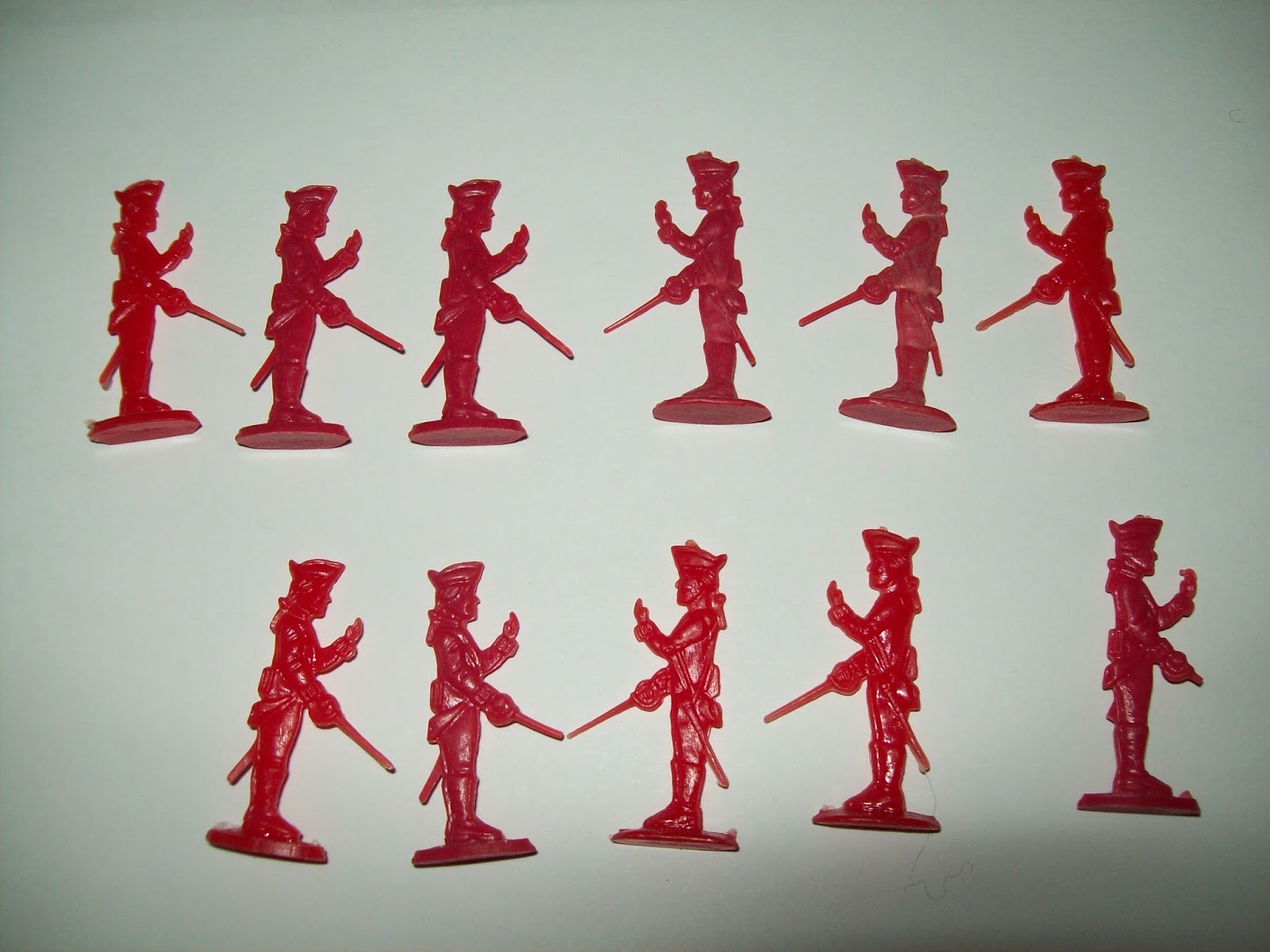
12 Hessian Troops
As with the Minutemen, these soldiers were meant for one side only.
This is different from the fully round soft plastic figures, as I have examples of blue American grenadiers and red Minutemen. I guess quality control was better back then.

Overall, these are much more brittle than the Roman Soldier sets. Their size, just over 30 mm, makes the foot soldiers incompatible with 1/72 figures and 40 mm figures. As you can see, they are pretty tall:


As an aside, I just photographed the red side. I did intend on standing them up in units, but I had a lot more trouble standing them up than I did with the Roman sets. Eventually I gave up. So with that in mind, here's the blue pile:

Wednesday, August 19, 2015

My Simple Rules


Here's a table long view of my two forces. Units of cavalry and infantry are all 6 bases strong. There are three infantry per base and one cavalry per base. Cavalry count as three infantry for casualty determination.
That is, it takes three "hits" to remove a base.
Artillery can only be destroyed if they are over run by the enemy.
GAME SEQUENCE:
Side A fires its cannon, all casualties are immediate.
Side A moves
Side A rolls its melee and fire dice.
Side B rolls any morale tests caused by casualties.
Side B fires its cannon, all casualties are immediate.
Side B moves
Side B rolls its melee and fire dice.
Side A rolls any morale tests caused by casualties.
END OF TURN.


These are the measuring devices used. They are copies of those used by the Tyne Tees television show 'Battleground!" hosted by Edward Woodward. Thankfully the Edgehill show is now free for all to see on Youtube. Peter Guilder figures and terrain and Callan himself hosting. The three colour dice is a block of balsa. Basically the roundshot sticks works as follows:
You place the base (the hinged end of the stick) in front of the firing gun and the other end over the target(s) you wish to hit. roll an ordinary 6 sided die. 5 or 6 means no adjustment. 1 through 4 means the device is moved right or left to match the rolled number. Then roll the three colour die. The colour shows which areas are capable of inflicting hits. Any figures covered are casualties. I mark the casualties with a dice that is placed next to the suffering unit. Once three hits are received, I remove a base and the marking dice.

Setting the Roundshot stick. The dice roll is good! A five, so no adjustment is needed.


In this example, the Roundshot stick is set and the dice roll is 4. The adjustment is made. The coloured die is rolled. If Blue is rolled in this instance, two figures would be casualties. As the unit already has 1 unit as a casualty (see the dice attached to the unit), one base would be removed and the white dice would be removed as well.


The cavalry movement stick. Pretty straightforward.


The casualties have started to add up.

The cavalry melee on the English right flank. The cavalry each roll one dice per base. 6's are hits.
MELEE
All units must be in two ranks. Cavalry attack with three figures in the first rank. They roll three dice in a melee. Any casualties are replaced form the rear rank.
Infantry fight in units three wide and two deep. They give fire with two dice (one base is pikemen with no weapons), but they melee with three dice.
 In a game of this size, refinements such as heavy cavalry advantages, terrain etc are largely ignored by a soloist like me. Three hits remove a base. The English (at left) have suffered one casualty. Leaders have little role other than colour and that they can add one to a unit's morale test.
MORALE
All units have a morale of 6 if they have 6 bases.
Once they aquire 3 hits and lose a base, their morale drops to 5 as they have only 5 bases.
They test morale by the roll of the dice. 5 and under they are OK. A 6 would be a failure of morale and the unit would turn tail and run. HOWEVER, a leader base can add ONE to a morale roll. In this case, raising the morale level from 5 to 6. Once a unit breaks and flees, it is gone for good.

A connundrum. Cannons can be blocked by their own troops. Any soldiers in the green zone are casualties, as are any in the appropriate coloured sections. In this case, the cannon can fire at the approaching cavalry on the right, but care must be taken so that a variation does not cause any friendly casualties.

More casualties.

The English foot begin their advance.

The casualties are adding up.

Odds and sods:
When a cavalry unit attacks an infantry unit, they attack the entire unit, even if they are only lined up against part of the infantry unit. A simplification borne out of DBA. Each base rolls 1 dice.
Giving Fire:
Infantry have two zones of fire, near and far. Far means that only a 6 is a hit. Near, 5 and 6 hit. Pistols only hit on a 6.
Cannister/grape. In the far section 5 or 6 hit, in the near section 4, 5, or 6 hit.

I think this is the meat and potatoes of my simple rules.
With smaller games and fewer figures greater variations can be introduced for heavy cavalry, experience etc., but a fun game can be had with "bang you're dead" rules as well.

A Pike And Shotte Review

I decided to dig out my pike and shot troops after watching Cromwell half a dozen times. Well, at least the parts from Edgehill to Naseby anyway. The film had a colourful cast of thousands led by Richard Harris and Alec Guiness. The battles had little to do with history, but they certainly are inspiring to a wargamer.


 These are some of my lobsters with very colourful trumpets and drums. The heavily armoured cavalry are later Knights from Giant Plastics (I have scads of them as shown in an earlier blog entry). The musicians are converted from those Thailand cowboys and indians I ordered a while back. The shooting cowboy aiming off into the blue makes a great trumpeter with the addition of plasticine and paint.

 A Minifig 25mm General accompanied by one of my cowboy standard bearers. I have a dozen Minifig commanders and I wish I could claim that I painted them, but they were an ebay purchase some time ago. They fit in nicely and do look the part.

 Part of the "English" Royalist army shown previously. I set up a vaguely English vs French battle, but truth be told it's a mix up of almost all my units.
 Some of the "French". I like the barrel barrow. I did that with an Airfix 8th Army lying soldier and some odds and ends. The big wagon is from an ebay win from an English man named Coombs. He made wonderful conversions, and they are sprinkled throughout my armies.


 My French commander at the left.
 The bare headed commander is the Airfix Sherriff of Nottingham on a Giant Knight's horse.
 These are some conversions I did to try and emulate some soldiers I saw in the Cromwell film. They are dragoons that are seen at Edgehill, when Timothy Dalton first rides up to the King. You see them also at Naseby, but only briefly. They have black fur hats and a red bag, and a red uniform. The movie shows them with white stripes, but for the life of me, I can't find a uniform reference in any of my books. Perhaps a fancy by the film makers, but too colourful for me to ignore.
 The English side again. A home made gun from Mr. Coombs, a multi barrel piece of ordnance. A good mix of my toys, Little Lead Soldiers, Giant, Warrior Miniatures, Airfix and Hong Kong, and Minifigs.

 Overall, I have nearly 800 figures on the table. It took me an evening to dig them out of their boxes and set them up on a table to photograph.


(Edit) I found more pix. Plus my sister shed her old laptop that I've been using to post with Chrome. Luckily I ended up with it (Thanks Kathryn!) and now can post more readily.